
Walk into the room of any first-year UPSC aspirant and you will find the same scene. Stacks of books on every surface. Titles highlighted, tabbed, and colour-coded. A collection that would impress a small library.
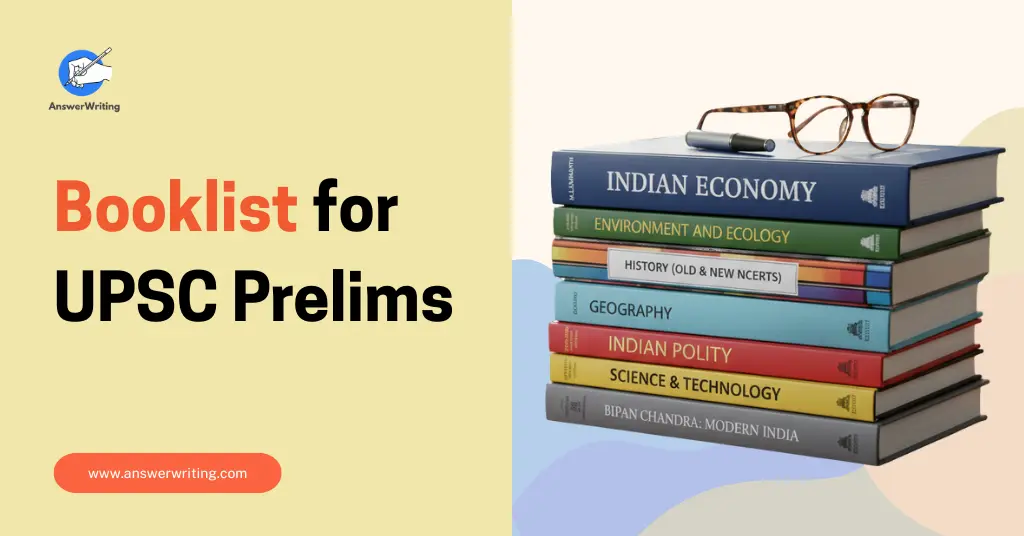
Ask them how many they have actually finished. The answer is almost always uncomfortable.
Over-collecting books is one of the most common and most damaging preparation habits in UPSC. It creates an illusion of preparation without the substance of it. Every new book feels like progress. But progress in UPSC comes from depth of reading, not breadth of collection.
The truth that toppers consistently share is this: the difference between a rank of 50 and a rank of 500 is rarely the booklist. It is how thoroughly, how repeatedly, and how analytically the same core books were read.
This post gives you the complete, subject-wise booklist for UPSC Prelims. More importantly, it tells you how to use each resource so that your reading actually translates into marks.
The Foundation: Why NCERTs Come First
Before any standard reference book, before any coaching material, before any current affairs compilation, there are NCERTs. Every serious UPSC educator, every topper interview, and every honest preparation guide says the same thing: start with NCERTs.
The reason is not that NCERTs are sufficient. They are not. The reason is that NCERTs build the conceptual architecture that makes every subsequent book more understandable and more retainable. An aspirant who reads Laxmikanth without NCERT Polity will memorise without understanding. An aspirant who reads the Economic Survey without NCERT Economics will drown in terminology. NCERTs are not a formality. They are the foundation.
Read each NCERT once for understanding. Then return to it for revision. Mark important facts, definitions, and concepts. The markings from your first read become your revision material for subsequent reads.
Which NCERTs to Read for UPSC Prelims
| Subject | Classes to Read | Priority |
|---|---|---|
| History: Ancient India | Class 6, 11 (Themes in World History) | High |
| History: Medieval India | Class 7, 11 (Themes in World History) | High |
| History: Modern India | Class 8, 10, 12 (Part 3) | Very High |
| Indian Polity | Class 9 (Democratic Politics I), Class 10 (Democratic Politics II), Class 11 (Political Theory) | Very High |
| Geography: Physical | Class 6, 11 (Fundamentals of Physical Geography) | Very High |
| Geography: India | Class 9 (Contemporary India I), Class 10 (Contemporary India II) | Very High |
| Geography: World | Class 12 (Fundamentals of Human Geography) | High |
| Economics | Class 9 (Economics), Class 10 (Understanding Economic Development), Class 11 (Indian Economic Development), Class 12 (Macroeconomics) | Very High |
| Science: Biology | Class 8, 9, 10, 12 (selected chapters) | High |
| Science: Physics and Chemistry | Class 8, 9, 10 | Moderate |
| Environment | Class 12 Biology (Ecology chapters) | High |
| Sociology | Class 11, 12 | Moderate |
Do not treat this as a list to collect. Treat it as a reading plan to execute. Most aspirants need three to four months to read all relevant NCERTs carefully and make meaningful notes from them.
Subject-wise Standard Books for UPSC Prelims GS Paper I
After NCERTs, move to standard reference books. The operative word is standard. These are the books that have a proven track record of covering the UPSC syllabus at the right depth. They are not the newest, the most comprehensive, or the most popular in a coaching centre. They are the ones that consistently help aspirants score marks.
History: Ancient, Medieval, and Modern
Ancient and Medieval India by Poonam Dalal Dahiya A reliable single-volume resource for ancient and medieval Indian history that goes beyond NCERTs without becoming unnecessarily encyclopaedic. Covers art, architecture, literature, and political history at the right Prelims depth. Use this after completing relevant NCERTs.
India’s Struggle for Independence by Bipan Chandra The gold standard for modern Indian history. This book covers the freedom struggle with analytical depth that is essential for both Prelims MCQs and Mains answers. Do not just memorise events. Read the causes, the debates among leaders, and the long-term significance of each phase of the movement.
A Brief History of Modern India by Spectrum Publications (Rajiv Ahir) A compact, exam-focused companion to Bipan Chandra. Useful for quick revision and for covering events and dates that the more analytical Bipan Chandra treats briefly. Many aspirants use both: Bipan Chandra for depth and Spectrum for coverage and revision.
Art and Culture by Nitin Singhania The most widely used resource for Indian art and culture in UPSC preparation. Covers architecture, sculpture, painting, music, dance, theatre, and cultural traditions comprehensively. UPSC Prelims consistently asks four to six questions on art and culture. This book covers that territory well.
Indian Polity and Constitution
Indian Polity by M. Laxmikanth There is no serious debate about this book. It is the single most important standard reference for Indian Polity in UPSC preparation. Covers the Constitution, Parliament, the Executive, the Judiciary, constitutional bodies, and federalism with comprehensive detail.
Read Laxmikanth twice. The first read should follow your NCERT Polity reading. The second read, closer to Prelims, should be a targeted revision of constitutional provisions, articles, and amendments that frequently appear in questions.
One caution: Laxmikanth is comprehensive, which means it contains more detail than Prelims strictly requires. Do not try to memorise every constitutional article and every committee recommendation. Focus on the concepts, the structural relationships between institutions, and the constitutional provisions that UPSC has historically tested.
Indian and World Geography
Certificate Physical and Human Geography by G.C. Leong The standard reference for physical geography. Covers landforms, climate systems, ocean currents, natural vegetation, and soils with clear explanations and helpful diagrams. UPSC Prelims geography questions on physical processes and world geography are well-covered by this book.
Geography of India by Majid Husain A comprehensive reference for Indian geography covering physical features, drainage systems, climate, soils, agriculture, industries, and transport. Use this after completing NCERT Geography for a deeper and more exam-relevant treatment of Indian geography topics.
Oxford School Atlas Maps are an essential part of geography preparation for Prelims. A good atlas is not optional. Practice locating rivers, mountain ranges, national parks, biosphere reserves, dams, ports, and international boundaries regularly. UPSC Prelims map-based questions reward aspirants who have spent time with a physical atlas rather than only reading text.
Indian Economy
Indian Economy by Ramesh Singh The most widely used standard reference for Indian economy in UPSC preparation. Covers economic concepts, planning history, sectors of the Indian economy, government schemes, and economic institutions. Accessible to aspirants from non-economics backgrounds.
Indian Economy by Nitin Singhania (Economy for UPSC) A more concise alternative that some aspirants prefer for its exam-focused structure. Useful as a companion or alternative to Ramesh Singh depending on your reading style.
Economic Survey (Current Year) Published annually by the Ministry of Finance, the Economic Survey is essential for both Prelims and Mains economy preparation. The summary chapters and key data tables are particularly important. Read the current year’s Economic Survey once carefully and note the key statistics, themes, and policy recommendations.
Union Budget (Current Year) The budget speech and key allocations are important for current affairs-linked economy questions. Read the budget highlights from quality newspapers and government summaries rather than the full budget document.
Environment and Ecology
Environment by Shankar IAS Academy The most widely recommended single resource for environment and ecology preparation. Covers biodiversity, climate change, pollution, environmental laws, international conventions, and conservation programmes. UPSC Prelims typically has eight to twelve environment questions annually, making this one of the highest-return subjects for focused preparation.
Shankar Environment book should be supplemented with current affairs on recent environmental developments: new species discoveries, changes to protected area boundaries, India’s international environmental commitments, and recent Supreme Court judgments on environmental matters.
NCERT Class 12 Biology (Ecology Section) The ecology chapters in Class 12 Biology provide the conceptual foundation for understanding ecosystems, biodiversity, and environmental degradation that more advanced resources build upon.
Science and Technology
There is no single universally recommended standard book for Science and Technology in UPSC Prelims. The subject is broad and fast-changing. The most effective approach combines:
NCERT Science (Class 8 to 10): Builds foundational science concepts for physics, chemistry, and biology questions.
NCERT Biology (Class 11 and 12, selected chapters): Human physiology, genetics, evolution, and biotechnology chapters are particularly relevant.
Science and Technology by Ravi Agrahari: A useful reference for UPSC-specific Science and Technology topics including space, biotechnology, defence technology, and emerging technologies.
Current Affairs for S&T: A significant proportion of S&T questions in Prelims come from recent developments: new satellite launches, medical breakthroughs, indigenous defence systems, and technology policy. Quality newspapers and monthly current affairs compilations are essential here.
Current Affairs
The Hindu or Indian Express (Daily): A quality national newspaper read daily is non-negotiable for UPSC Prelims. The Hindu is the more widely recommended choice for its depth of coverage on governance, international affairs, science, and environment. Indian Express is preferred by some aspirants for its analytical journalism.
Read with purpose. Do not read every article. Focus on national and international news of policy significance, government schemes and their outcomes, appointments to constitutional bodies, international agreements India signs, and developments in science, environment, and economy.
Vision IAS Monthly Current Affairs or Insights IAS Monthly: Monthly current affairs compilations from reputed platforms save time and ensure comprehensive coverage of exam-relevant developments. Use these for revision and to catch developments you may have missed in daily newspaper reading.
PIB (Press Information Bureau): Government announcements, scheme launches, and policy developments are covered most accurately on the PIB website. Bookmark it and check it weekly.
Booklist for UPSC Prelims CSAT (GS Paper II)
| Book | Best For | Priority |
|---|---|---|
| NCERT Mathematics (Class 8, 9, 10) | Building numeracy foundation | High for weak mathematics aspirants |
| Quantitative Aptitude by R.S. Aggarwal | Arithmetic and numeracy practice | High |
| Analytical Reasoning by M.K. Pandey | Logical reasoning and analytical ability | High |
| CSAT Paper II by Arihant Publications | Comprehensive CSAT coverage | Moderate |
| Past UPSC CSAT Papers (2011 onwards) | Most accurate exam-style practice | Very High |
As noted in previous sections, the most valuable CSAT resource is past UPSC papers. No coaching material matches the actual paper in question style and difficulty calibration. Solve every available past CSAT paper under timed conditions before your exam.
What NOT to Read for UPSC Prelims
This section is as important as the booklist itself. Over-reading is a preparation disease. These are the resources that cost aspirants more time than they return in marks.
| Resource to Avoid | Why to Avoid It | Better Alternative |
|---|---|---|
| Multiple books on the same subject | Creates confusion, wastes time, and delays completion | Choose one standard book per subject and read it thoroughly |
| Advanced academic texts for Prelims topics | Far more depth than Prelims requires. Leads to over-preparation of narrow topics | Stick to standard references designed for UPSC |
| Multiple current affairs magazines simultaneously | Creates overlap, redundancy, and information overload | Choose one quality monthly compilation and read it completely |
| Previous year papers of state PSC exams as primary practice | Different syllabus and question style from UPSC. Can mislead preparation | Focus on UPSC previous year papers above all else |
| Social media “important topics” lists | Often inaccurate, speculative, and anxiety-inducing | Trust the official syllabus and standard resources |
| Coaching institute printed notes as primary resource | Notes compress information but remove the understanding that comes from reading full books | Use notes for revision after reading standard books, not as a replacement |
How to Read Your Booklist Effectively
Having the right books is necessary but not sufficient. How you read determines how much you retain and how well you perform.
Read with the syllabus in front of you. Before opening any book, know which syllabus entry it covers. This keeps your reading purposeful and prevents you from spending equal time on high and low-priority topics.
Make notes during your first read. Not lengthy notes. Margin annotations, underlined facts, and short summaries at the end of each chapter. These become your revision material.
Revise more than you read new material. The human memory requires repetition. One careful read followed by three revisions retains more than four first-time reads of different books. Build revision cycles into your preparation calendar from the first month.
Use previous year questions to test your reading. After completing a subject, attempt the last five years of UPSC Prelims questions on that subject. Your performance tells you whether your reading depth is sufficient or whether you need to return to the book for deeper engagement.
Read actively, not passively. After each paragraph or section, close the book and try to recall what you just read. This active recall practice dramatically improves retention compared to passive page-turning.
Quick Reference: Complete Prelims Booklist at a Glance
| Subject | Primary Book | Supplementary Resource |
|---|---|---|
| Ancient and Medieval History | NCERT Class 6, 7, 11 + Poonam Dalal Dahiya | Previous Year Questions |
| Modern History | Bipan Chandra + Spectrum | NCERT Class 8, 10, 12 |
| Art and Culture | Nitin Singhania | Cultural Ministry website for current developments |
| Indian Polity | Laxmikanth | NCERT Class 9, 10, 11 |
| Physical Geography | G.C. Leong | NCERT Class 11 Physical Geography |
| Indian Geography | Majid Husain | NCERT Class 9, 10 Contemporary India |
| Maps and Locations | Oxford School Atlas | Daily map practice |
| Indian Economy | Ramesh Singh | Economic Survey (current year) |
| Environment and Ecology | Shankar IAS Environment | NCERT Class 12 Ecology chapters |
| Science and Technology | Ravi Agrahari + NCERT Science | Current affairs (newspapers) |
| Current Affairs | The Hindu or Indian Express (daily) | Vision IAS or Insights Monthly |
| CSAT Numeracy | R.S. Aggarwal | NCERT Math Class 8 to 10 |
| CSAT Reasoning | M.K. Pandey | Past UPSC CSAT Papers |
FAQs on UPSC Prelims Booklist
1. Is it necessary to read all NCERTs or can I skip some?
You can strategically prioritise NCERTs based on your existing knowledge and time available. Modern history NCERTs, Polity NCERTs, and Geography NCERTs are the most critical and should not be skipped. Science NCERTs can be selectively read (Class 8 to 10 for basics, Class 12 Biology for relevant chapters). Economics NCERTs are important for conceptual foundation. If time is very limited, prioritise Class 11 and 12 NCERTs in each subject as they tend to be more UPSC-relevant than lower classes.
2. Is Laxmikanth alone sufficient for Indian Polity or do I need additional books?
For Prelims, Laxmikanth is sufficient for the vast majority of polity questions when read carefully and revised thoroughly. Some aspirants supplement with D.D. Basu’s Introduction to the Constitution of India for conceptual depth on constitutional provisions. For Mains, additional reading on contemporary governance issues through newspapers and committee reports is necessary. But for Prelims, two thorough reads of Laxmikanth with active revision covers the polity syllabus very well.
3. Should I read both The Hindu and Indian Express daily?
No. Reading both daily is time-consuming and creates information overload without proportional benefit. Choose one, read it thoroughly and analytically, and stick with it. Supplement your chosen newspaper with weekly or monthly current affairs compilations to ensure comprehensive coverage. Consistency in reading one source deeply is more effective than switching between sources or reading both partially.
4. How many previous year papers should I solve before Prelims?
Solve at least the last ten years of UPSC Prelims papers, ideally the last fifteen. Previous year papers are your single most accurate guide to UPSC’s question style, difficulty calibration, and subject-wise emphasis. After solving each paper, conduct a detailed error analysis: which subjects produced the most errors, which question types were most challenging, and which facts you did not know. That analysis drives your targeted revision.
5. Are coaching institute printed notes a good substitute for standard books?
Notes are useful for revision but are a poor substitute for first-read preparation. Standard books build understanding through explanation, context, and examples. Notes compress information into facts and points, which are easier to memorise but harder to genuinely understand. The most effective approach is to read standard books for understanding and use notes (whether your own or coaching notes) for revision. Never use notes as your primary first-read resource for an important subject.
6. Should I buy the latest edition of standard books every year?
For most standard books, the core content changes minimally between editions. Laxmikanth, G.C. Leong, and Bipan Chandra do not need annual replacement. However, for resources that cover current and recent developments (Ramesh Singh’s economy book, Shankar Environment, Nitin Singhania’s culture book), checking whether a new edition covers recent policy changes or new data is worthwhile. For current affairs resources specifically, always use the most recent available material.
Final Thought
The perfect UPSC Prelims booklist is not the longest one. It is not the most comprehensive one. It is the one you will actually read, completely, multiple times, with genuine understanding and active revision.
Every book on this list has been recommended because it covers its subject at the right depth for UPSC Prelims, has a track record of helping aspirants score marks, and works best when read as part of a coherent, syllabus-driven preparation plan.
Collect fewer books. Read them more. Revise them repeatedly.
That is the strategy. Everything else is noise.