
Most aspirants spend three to four months making beautiful notes. Color-coded. Neatly underlined. Perfectly organized. Then, six months later, they open those notes and realize they cannot use them. The notes are too long to revise. Too detailed to skim. Too close to the original textbook to add anything new.
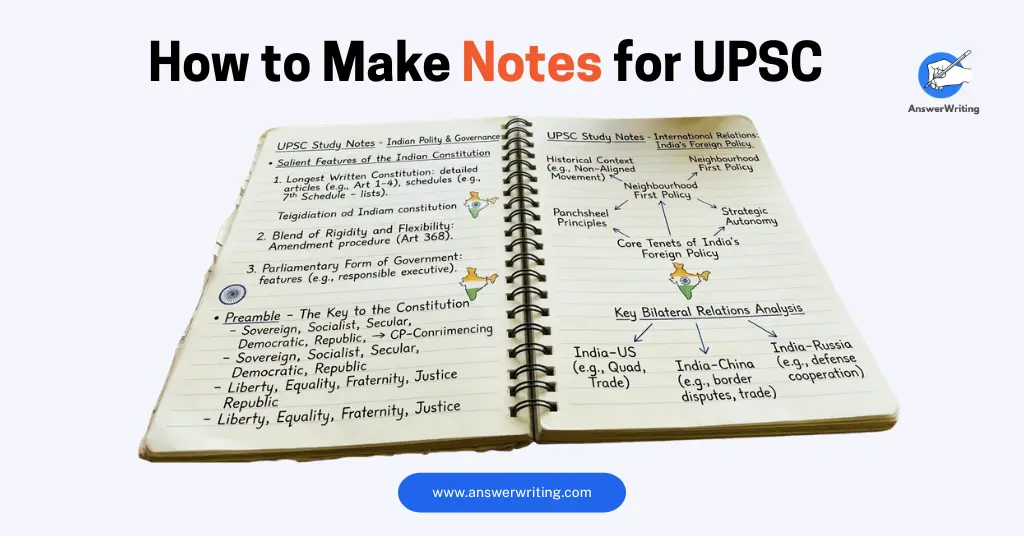
Sound familiar? You are not alone. Note-making is one of the most misunderstood parts of UPSC Mains preparation.
The Problem With How Most Aspirants Make Notes
The most common mistake is treating note-making as copying. Aspirants read a chapter, then rewrite it in slightly shorter form. This feels productive. It is not.
You have not processed the information. You have just relocated it from a book to a notebook. When exam time comes, you still need to read those notes like a book. That defeats the purpose entirely.
The second mistake is making notes too early. Many first-year aspirants start making elaborate notes before they have even read the full syllabus once. The result is notes without context, notes that miss connections, and notes that need to be remade anyway.
Good note-making begins after your first reading. Not during it.
What UPSC Mains Actually Demands From Your Notes
Prelims and Mains are fundamentally different exams. Your notes need to reflect that difference.
| Feature | Prelims Notes | Mains Notes |
|---|---|---|
| Purpose | Quick recall of facts | Structured arguments and analysis |
| Format | Short points, keywords | Frameworks, dimensions, examples |
| Length | Minimal | Moderate but organized |
| Use | Last-minute revision | Answer writing practice and revision |
| Current Affairs | Fact-based | Policy analysis, implications, way forward |
| Key Skill Tested | Recognition | Expression and evaluation |
Mains answers require you to think on paper under time pressure. Your notes must train you to do exactly that.
The Golden Rule: Notes Are for Revision, Not for Reading
Read that again.
Your notes are not a replacement for your source material. They are a trigger. A good note should remind you of an entire concept in 30 seconds. It should not explain the concept from scratch.
If your notes require 10 minutes to read one page, they are too long. A well-made Mains note page should be revisable in 2 to 3 minutes.
This single principle, if followed strictly, will transform how you approach note-making.
What Your Notes Must Contain
Every page of your Mains notes should have most of these six elements.
- Core concept or definition: One or two lines. Precise and exam-ready. This becomes your answer’s opening statement.
- Key dimensions or aspects: How does this topic connect to social, economic, political, legal, or environmental angles? UPSC loves multi-dimensional answers.
- Constitutional or legal basis: Articles, Acts, Schedules, Amendments, or landmark judgments where applicable. These add credibility to your answers.
- Government schemes or policy initiatives: Relevant programmes, committees, or policy reforms. These show awareness of governance realities.
- Data points or reports: One or two relevant statistics from credible sources like NITI Aayog, World Bank, UN reports, or government surveys. Numbers make answers authoritative.
- Current Affairs peg: A recent development that connects to this static topic. This shows the examiner you are reading the present through the lens of your syllabus.
Not every note will have all six. But the more elements you can pack into a structured page, the more useful that page becomes during answer writing.
Subject-Wise Note-Making Strategy
Polity and Governance
Polity has a large static base and a growing governance overlay. Your notes need to capture both.
For constitutional topics, structure your notes around: the Article or provision, its scope and limitations, related constitutional bodies, landmark judgments, and recent amendments. For example, a note on Article 356 (President’s Rule) should include the Sarkaria Commission findings, the S.R. Bommai judgment, and recent instances of its use.
For governance topics, use a problem-solution-way forward framework. Note the issue, the constitutional or legal mandate, existing mechanisms, their limitations, and reform suggestions (from ARC reports, Law Commission, or Parliamentary Standing Committees).
Keep a separate running list of recent government schemes with their objectives, nodal ministry, and relevance to syllabus topics.
History and Culture
Mains History questions are rarely factual. They ask you to analyze, compare, and evaluate. Your notes must reflect this.
For Modern History, organize notes thematically rather than chronologically. Themes like the nature of early nationalism, peasant movements, role of women in the freedom struggle, and Gandhi’s political philosophy recur in Mains. Chronological notes force you to hunt for relevant content. Thematic notes place it directly in front of you.
For Culture, build a matrix-style note for art forms, classical music, dance, and architecture. Columns can include: period, region, key features, UNESCO status (if any), and associated names. This format is fast to revise and easy to recall.
Geography
Geography notes work best in visual form. Hand-drawn maps, annotated diagrams, and flowcharts outperform plain text for this subject.
For physical geography (monsoon, soils, drainage), use flowcharts to show cause-effect relationships. For human geography (urbanization, migration, agriculture), use data-supported notes with recent Census figures and government scheme linkages.
Always connect geographic facts to current events. A note on the Western Ghats should include recent news on landslides, biodiversity threats, and the Gadgil Committee recommendations.
Economy
Economy is best noted in two layers. The first layer is conceptual: what is fiscal deficit, how does the repo rate transmission work, what does the current account deficit mean. The second layer is current: what is India’s fiscal deficit today, what has RBI done with rates recently, what does the Economic Survey say.
Maintain a dedicated “Economic Indicators” page that you update every quarter. Include GDP growth rate, inflation (CPI and WPI), fiscal deficit as a percentage of GDP, forex reserves, and unemployment figures. This single page becomes your data ammunition for any Economy question.
For schemes and institutions, a table works best: scheme name, year of launch, objective, nodal ministry, and recent performance data.
Environment and Ecology
Environment notes need to be both conceptual and treaty-heavy. UPSC frequently asks about international environmental agreements, India’s commitments, and domestic legislation.
Maintain a dedicated treaties and conventions page. For each treaty, note: year, location, key provisions, India’s position, and related domestic law. For example, a note on the Convention on Biological Diversity should connect to the Biological Diversity Act 2002, the National Biodiversity Authority, and India’s biodiversity targets under the Kunming-Montreal Global Biodiversity Framework.
For ecology concepts (ecosystems, food chains, biodiversity hotspots), use labeled diagrams wherever possible. A diagram of trophic levels or the nitrogen cycle is faster to revise than three paragraphs of text.
Ethics (GS Paper IV)
Ethics notes are fundamentally different from every other subject. Definitions matter here, but application matters more.
Build a thinkers and their ideas page. For each philosopher (Kant, Aristotle, Gandhi, Rawls), note: their core ethical framework, one key quote, and its application to public administration or governance. Examiners reward answers that cite thinkers accurately and apply them meaningfully.
Maintain a case studies bank. For each case study theme (conflict of interest, whistleblowing, corruption dilemmas), note two or three real or hypothetical scenarios with structured responses. The 250-word Ethics answer has a near-fixed structure: identify the ethical issue, list stakeholders, present options, apply a framework, choose a course of action, and justify it.
Your notes should make that structure second nature.
Essay
Most aspirants do not make notes for Essay. This is a serious gap.
Build an ideas and quotes bank. Organize it by theme: democracy, development, women, environment, technology, governance, education. For each theme, note three to four quality quotes, two or three data points, one historical reference, and one contemporary example.
When you sit for Essay Paper, you spend the first 10 minutes on a mind map. Your notes bank feeds that mind map. Without it, you are drawing on whatever randomly comes to mind under pressure.
How to Integrate Current Affairs Into Static Notes
Current Affairs is not a separate subject. It is the living layer on top of your static syllabus. Here is a practical integration method.
Step 1: Read a news item or monthly magazine summary. Identify which GS paper and which static topic it connects to.
Step 2: Go to your existing static note for that topic. Add a small “Current Peg” box at the bottom or margin.
Step 3: Write two to three lines: what happened, why it matters, and which dimension of the static topic it illustrates.
Step 4: Review all Current Pegs during your weekly revision. This reinforces both the static concept and the current development simultaneously.
This method prevents the common problem of having a thick Current Affairs file that is disconnected from your GS answers. Every current event you note gets directly attached to a syllabus topic. That is exactly how toppers use current affairs in their answers.
Digital Notes vs. Handwritten Notes
This debate has no universal answer. But the data from toppers leans in one direction.
| Parameter | Digital Notes | Handwritten Notes |
|---|---|---|
| Speed of making | Faster | Slower |
| Ease of editing | Very easy | Messy with revisions |
| Retention | Lower (research suggests) | Higher (motor memory) |
| Exam simulation | Poor | Strong |
| Portability | High | Moderate |
| Diagrams and maps | Difficult | Easy and natural |
| Risk of loss | Low (with backup) | High |
| Best suited for | Current Affairs, schemes, data | Static concepts, frameworks, Ethics |
The practical recommendation: use digital tools (Notion, OneNote, Google Docs) for Current Affairs and data-heavy content that changes frequently. Use handwritten notes for static GS content, Ethics frameworks, and Essay idea banks.
Since UPSC Mains is a handwritten exam, spending time writing by hand also builds speed and legibility. That alone makes handwritten notes worth the effort for core content.
The Revision Cycle: How to Keep Notes Alive
Notes that are not revised become dead weight. Most aspirants make notes and never return to them systematically. Here is a simple revision cycle that works.
Week 1: Make notes on a topic after first reading.
Week 3: Revise those notes before moving to the next related topic. Add any new connections you have found.
Month 3: Do a full subject-level revision. Cover all notes for one GS paper in one sitting. Identify gaps.
Month 6: Do a cross-subject revision. Look at how Polity connects to Governance, how Economy connects to Environment, how Ethics connects to every GS paper.
Final 2 months: Revise only notes. No new material. No new books. Just your notes, your answer writing practice, and mock tests.
This cycle keeps your notes relevant and your preparation layered.
How Answer Writing Practice Connects to Your Notes
Note-making and answer writing are two sides of the same coin. Notes feed your answers. Answer writing reveals the gaps in your notes.
When you write a practice answer and realize you cannot recall a relevant judgment, a data point, or a policy example, that is your notes telling you something is missing. Go back and fill that gap.
Platforms like AnswerWriting.com make this loop structured and efficient. Aspirants can upload handwritten answers and receive detailed evaluations from experienced mentors. Teachers on the platform can also manage and evaluate answers at scale. The feedback loop between writing an answer and getting it evaluated is exactly what sharpens both your notes and your exam performance over time.
The best use of such a platform is not just to get marks. It is to identify the specific content and structural weaknesses in your answers and then return to your notes to address them.
Common Note-Making Mistakes to Avoid
- Starting too early: Making notes during your first reading produces shallow, context-less content. Read first. Note second.
- Over-length notes: If your notes are longer than 30% of the source material, they are too long.
- Copying without processing: Paraphrase everything. If you cannot put it in your own words, you have not understood it.
- Subject silos: Keeping Polity, Economy, and Governance in completely separate notebooks breaks the cross-linkages that UPSC rewards.
- No current affairs integration: Static notes without a current peg are incomplete for Mains purposes.
- Never revising: Notes that sit untouched for months are worse than no notes, because they give you false confidence.
- Ignoring diagrams and flowcharts: Plain text notes for Geography, Environment, and Science miss the fastest revision format available.
- Making fresh notes before each test: Revise existing notes. Do not rewrite them. Rewriting is not revision.
FAQs
Q1. When should I start making notes for UPSC Mains?
Start after your first complete reading of a subject. Making notes during the first read creates shallow, disconnected content. A second read with notes is far more productive because you understand the full scope of the topic before you decide what is worth noting.
Q2. How long should my notes be for a single GS topic?
A good rule: one to two pages maximum for a core topic. If you are spilling into four or five pages, you are noting too much. Ask yourself: will I read this entire page 10 times before the exam? If the answer is no, cut it.
Q3. Should I make separate notes for Prelims and Mains?
Yes. Prelims notes are keyword-heavy and fact-dense. Mains notes are framework-heavy and analysis-oriented. Trying to use one set for both creates confusion. Many aspirants maintain a single base note and add a “Mains layer” on top of it, which is a practical middle ground.
Q4. How do I handle Current Affairs for Mains notes?
Do not maintain a standalone Current Affairs file. Instead, attach current developments directly to your static topic notes using a “Current Peg” system. This ensures every current event is contextualized within the syllabus rather than floating in isolation.
Q5. Is it okay to use printed notes or coaching material instead of making my own?
Printed notes save time but reduce retention. They also cannot capture your personal examples, your writing style, or your specific gaps. Use printed notes as a reference or starting point. Always process them into your own language before they become useful for answer writing.
Start Today, Not Tomorrow
The best time to build a strong notes system was the first day of your preparation. The second best time is today.
Do not wait to finish a subject before starting your notes. Do not wait for the perfect notebook or the perfect app. Pick one topic you have already read, open a page, and apply the six-element framework.
One structured note, made well and revised often, is worth more than fifty pages of beautiful-but-useless copying. Build notes that serve your answers. Build answers that reveal gaps in your notes. That loop, repeated consistently, is how UPSC Mains gets cracked.