
Most aspirants who fail Prelims do not fail because they did not study enough. They fail because they revised the wrong things, in the wrong order, at the wrong time.
The preparation phase builds your knowledge base. The revision phase determines how much of that base you can access under exam pressure. These are two completely different cognitive tasks, and they require two completely different strategies.
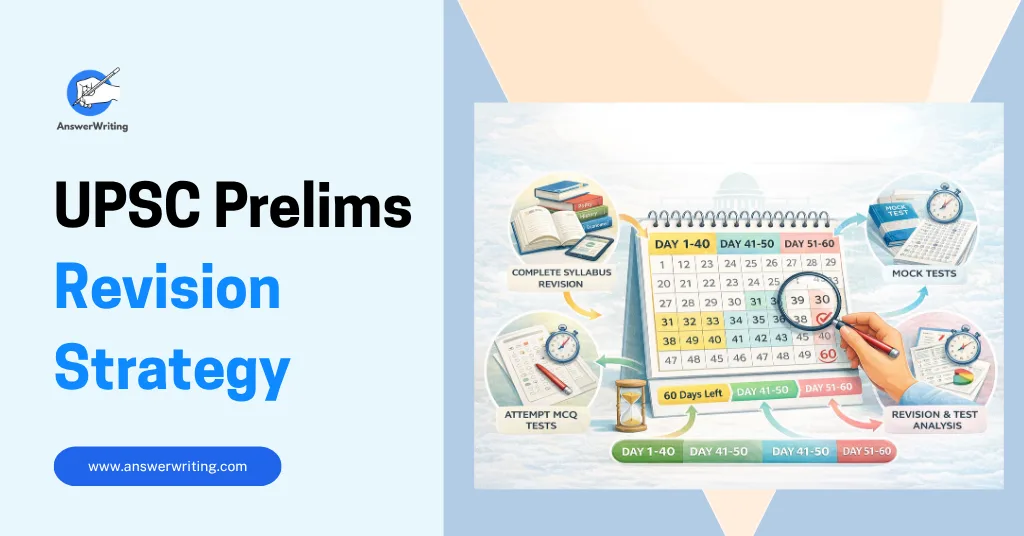
This post gives you a concrete, subject-wise, phase-wise revision framework for the final 60 days before Prelims. It is built on topper patterns, PYQ analysis, and the hard lessons of aspirants who cleared the cutoff on their second or third attempt after fixing their revision approach.
Why Prelims Revision Fails: The Real Reasons
The most common revision mistake is re-reading. An aspirant opens their Polity book, reads through chapters they have already covered, feels productive, and moves on. Two weeks later, they cannot recall half of what they re-read.
Re-reading creates familiarity, not retention. It feels like learning because the content seems familiar as you read it. But familiarity is not the same as recall. In the exam hall, you need recall, not recognition.
Effective revision is active, not passive. It means testing yourself, not re-reading yourself.
The second failure pattern is coverage anxiety. As Prelims approaches, many aspirants panic about topics they have not covered thoroughly and start adding new material. This is almost always a mistake. At the revision stage, consolidating what you know delivers far better returns than adding what you do not know.
The third pattern is comfort-based revision. Aspirants naturally gravitate toward subjects they enjoy or feel confident about. History lovers revise History repeatedly. Economy-averse aspirants avoid Economy until the last week. The result is an unbalanced preparation that leaves high-weightage gaps exposed.
Effective revision is systematic, not emotional.
Build Your Revision Arsenal First
Before you begin revising, spend two to three days organizing your revision material. This investment saves significant time later.
Your revision material should be concise, personally made, and source-consolidated. The ideal revision arsenal looks like this:
Subject-wise short notes: These should be your own notes, not photocopied content. They should capture key facts, article numbers, judgment names, committee recommendations, and conceptual frameworks in your own words. If your notes run longer than 15 to 20 pages per subject, they are too detailed for rapid revision. Condense them.
PYQ booklets organized by subject: Collect and organize previous year Prelims questions (last 10 years) by subject. These become your primary diagnostic tool during revision.
Current affairs consolidation document: A single document covering the last 12 months of exam-relevant current affairs, organized by subject. Do not maintain multiple sources for current affairs during the revision phase.
One-liners and fact sheets: For subjects like History and Science and Technology, a condensed one-liner sheet covering high-frequency facts saves valuable time in the final two weeks.
If your revision material is scattered across multiple books, printed notes, and online sources, consolidate it before starting the revision clock. Switching between sources during revision fragments your attention and slows the process significantly.
Subject-Wise Weightage: Revise by Priority, Not by Comfort
UPSC Prelims GS Paper 1 has 100 questions. The subject-wise distribution varies year to year, but the broad pattern across the last 10 years is consistent enough to guide revision priority.
| Subject | Average Questions (Last 10 Years) | Revision Priority |
|---|---|---|
| History and Culture | 18 to 22 | Very High |
| Polity and Governance | 14 to 18 | Very High |
| Economy | 12 to 16 | High |
| Environment and Ecology | 12 to 15 | High |
| Geography | 10 to 14 | High |
| Science and Technology | 8 to 12 | Medium-High |
| Current Affairs | 15 to 20 | Very High |
| Miscellaneous | 5 to 8 | Medium |
Two observations from this data:
First, History and Culture combined with Current Affairs can account for 35 to 42 questions in a single paper. These two areas alone justify the highest revision investment.
Second, no subject has zero questions. Even “Miscellaneous” (which includes international organizations, awards, sports, and government schemes) contributes 5 to 8 questions that can make or break a cutoff attempt.
Revise in order of weightage, not in order of comfort.
The 60-Day Prelims Revision Plan
Phase 1: Days 1 to 30 (Foundation Reinforcement)
The first 30 days are about systematic subject-by-subject revision using your notes and PYQs together.
Allocate 2 to 3 days per subject in the following sequence: Polity, Modern History, Economy, Geography, Ancient and Medieval History, Environment, Science and Technology, and Art and Culture.
For each subject, follow this daily routine:
Spend the first half of the day revising your notes actively. Cover your notes and try to recall the content before reading it. This forced recall technique, known as the retrieval practice method, significantly improves long-term retention compared to passive re-reading.
Spend the second half solving PYQs for that subject. Do not just answer them. Analyze every question you get wrong and every question you got right by guessing. Both reveal gaps in understanding.
By the end of Phase 1, you should have completed one full revision of every static subject and identified your specific weak areas through PYQ analysis.
Phase 2: Days 31 to 45 (PYQ Integration and Gap Filling)
Phase 2 has two parallel tracks.
Track 1: Address the weak areas identified in Phase 1. Go back to your source material only for those specific gaps. Do not restart full subject revisions. Targeted gap filling is the goal.
Track 2: Integrate current affairs with static knowledge. For every current affairs item in your consolidation document, identify the static syllabus topic it connects to. A news item about a new species discovered in the Western Ghats connects to Environment and Biodiversity. A Supreme Court judgment connects to Polity. This integration approach prepares you for the hybrid static-current affairs questions that UPSC increasingly favors.
Start taking one full-length mock test every 4 to 5 days from Day 35 onward. Review each mock thoroughly before taking the next one.
Phase 3: Days 46 to 60 (Mock Tests and Rapid Revision)
Phase 3 is about consolidation and exam conditioning.
Take a full-length mock test every 2 to 3 days. Time yourself strictly. Simulate exam conditions: no phone, no breaks, same time of day as the actual exam.
Between mocks, do rapid revision from your one-liner fact sheets and condensed notes only. Do not return to full books or long notes at this stage.
Spend 30 minutes daily on current affairs review from your consolidation document.
Reserve the last 3 days before the exam for light revision only. No new mocks. No new material. Only familiar content revisited calmly.
How to Revise Each Subject Effectively
History and Art and Culture
History is the highest-weightage static subject in Prelims. UPSC has shifted significantly toward Art and Culture questions in recent years, making this sub-section particularly important.
For Modern History, revise chronologically but focus on themes: social reform movements, revolutionary nationalism, constitutional developments, and the Gandhi era. Use a timeline chart to reinforce sequence-based questions.
For Ancient and Medieval History, focus on dynasties, their administrative systems, cultural contributions, and religious movements. Specific rulers, their courts, and their policy decisions are frequent question sources.
For Art and Culture, revise Nitin Singhania’s notes chapter by chapter. Classical dance forms, musical traditions, temple architecture styles, and painting schools are consistently tested. Use visual aids wherever possible: looking at images of architectural styles reinforces retention better than text alone.
Polity
Polity revision must be article-specific. Vague conceptual revision is not enough for Prelims MCQs, which often test precise constitutional provisions.
Maintain a condensed article reference sheet covering: Fundamental Rights (Articles 12 to 35), DPSPs (Articles 36 to 51), Fundamental Duties (Article 51A), Emergency provisions (Articles 352, 356, 360), and key institutional articles (Parliament, Judiciary, CAG, Election Commission).
Revise landmark Supreme Court judgments with their year and constitutional significance. UPSC frequently frames questions around what a specific judgment established or struck down.
Economy
Economy revision requires both conceptual clarity and current data. Revise core concepts (GDP measurement, inflation types, monetary policy tools, fiscal policy) from your notes. Then update with current data from the Economic Survey summary and recent RBI policy decisions.
Pay particular attention to government schemes. UPSC tests scheme names, their ministry linkages, beneficiary categories, and objectives. Maintain a schemes table in your revision material.
Geography
Geography revision is most effective when done with a map. For every geographical feature you revise (river, pass, plateau, soil type, climate zone), locate it on your atlas.
Focus particularly on: river systems and their tributaries, Indian climate patterns and monsoon dynamics, soil types and their agricultural significance, and biosphere reserves and national parks. These are consistently high-frequency areas.
Environment and Ecology
Environment revision should cover both static concepts (ecosystem types, biodiversity hotspots, conservation categories) and current environmental affairs (recent COP decisions, NGT judgments, India’s climate commitments).
Revise international conventions and their key provisions: CITES, Ramsar, CBD, UNFCCC, and the Paris Agreement. UPSC frequently tests which convention covers which category of conservation.
Science and Technology
S&T revision is primarily current affairs driven. Revise your running S&T notes document covering space missions, defense technology, biotechnology developments, and emerging technology applications.
For static S&T, NCERT Science (Classes 8 to 10) covers the foundational concepts behind most Prelims questions. Do not attempt to add new technical sources at the revision stage.
Current Affairs
Revise your consolidation document by subject category, not chronologically. Group all environment-related current affairs together, all economy-related items together, and so on. This subject-wise grouping reinforces the static-current affairs connections that are essential for hybrid questions.
The PYQ Method: Your Most Underused Revision Tool
Previous Year Questions are the closest thing to a UPSC Prelims syllabus with marks attached. They tell you not just what topics UPSC tests but how UPSC frames questions on those topics.
The 10-year PYQ analysis approach works as follows:
Solve all PYQs from the last 10 years, subject by subject. Do this under timed conditions, not casually.
After solving, categorize every question into three buckets: questions you answered correctly with confidence, questions you answered correctly by elimination or guessing, and questions you answered incorrectly.
The second and third buckets are your revision priority list. Every question in those buckets points to a specific knowledge gap or a conceptual weakness in how UPSC frames that topic.
For frequently repeated topics (federalism, biodiversity conventions, economic terminology, historical movements), PYQs reveal the exact angle UPSC uses. Revising those topics through the lens of how they have been tested, rather than how they are explained in books, sharpens your exam-specific understanding significantly.
A practical target: aspirants who can correctly answer 75 to 80 percent of PYQs from the last 10 years with genuine understanding (not memorized answers) are in a strong position for the actual exam.
Current Affairs Revision: What to Keep and What to Drop
Current affairs revision in the final 60 days requires ruthless prioritization. You cannot revise 12 months of news comprehensively in this phase. You should not try.
Keep:
- Current affairs that connect directly to static syllabus topics
- Government schemes launched or significantly updated in the last 12 months
- International agreements and summits with India’s participation
- Important Supreme Court judgments from the last 12 months
- Major appointments to constitutional bodies
- Key economic data: GDP growth rate, inflation figures, RBI policy decisions
Drop:
- Purely event-based news with no syllabus connection
- Sports news beyond major international events
- State-level news not connected to national policy
- Detailed biographical information about award winners (know the award and field, not the full biography)
The 6 months immediately preceding the Prelims date carry the highest current affairs weightage. Prioritize this window for detailed revision. The 6 months before that require lighter, thematic revision rather than event-by-event recall.
Mock Test Strategy During Revision
| Phase | Mock Frequency | Time of Day | Review Protocol |
|---|---|---|---|
| Days 35 to 45 | 1 mock every 4 to 5 days | Same time as actual exam | Full review: every wrong answer analyzed |
| Days 46 to 55 | 1 mock every 2 to 3 days | Same time as actual exam | Priority review: wrong answers + lucky correct answers |
| Days 56 to 60 | 1 mock only | Same time as actual exam | Light review: patterns and confidence calibration |
| Final 3 days | No mocks | Rest and light revision | No new tests: protect mental freshness |
Three rules for mock test effectiveness:
Never take a mock without reviewing it fully. An unreviewed mock is a wasted 3 hours.
Never take two mocks on consecutive days without a review day between them. Review days are where improvement happens, not test days.
Always take mocks at the same time of day as the actual exam. This conditions your mental alertness to peak at the right time.
The Last 7 Days: A Day-by-Day Framework
- Day 7 before exam: Complete rapid revision of Polity and Modern History from condensed notes only.
- Day 6 before exam: Rapid revision of Economy and Government Schemes. Review current affairs consolidation document (first half).
- Day 5 before exam: Rapid revision of Geography and Environment. Review current affairs consolidation document (second half).
- Day 4 before exam: One full-length mock test under strict exam conditions. Light review of results. No deep analysis at this stage.
- Day 3 before exam: Rapid revision of Art and Culture, Ancient and Medieval History, and Science and Technology one-liners.
- Day 2 before exam: No new revision. Review your mistakes register and one-liner fact sheets only. Sleep by 10 PM.
- Day 1 (exam eve): No studying after noon. Light reading of your condensed notes if needed for reassurance. Prepare exam materials. Sleep early.
The instinct to study intensely on the final two days is understandable but counterproductive. Mental fatigue on exam day costs more marks than any last-minute revision can recover.
CSAT: How Much Attention Does It Really Need?
CSAT (Paper 2) is qualifying in nature. You need 33 percent, which means 66 marks out of 200. For most aspirants with a graduation-level education, this is achievable without intensive preparation.
Who can maintain with minimal effort: Aspirants with strong English comprehension, basic mathematical reasoning, and logical thinking skills. For this group, solving one CSAT mock per week during the revision phase is sufficient to stay calibrated.
Who needs dedicated preparation: Aspirants who have struggled with CSAT in previous attempts, those with limited English medium exposure, and those who find mathematical reasoning or data interpretation consistently difficult. For this group, allocate 45 to 60 minutes daily to CSAT practice throughout the revision phase.
Do not make the mistake of completely ignoring CSAT until the final week. Failing the qualifying paper invalidates your GS Paper 1 score entirely, regardless of how well you performed on it.
A practical CSAT strategy: focus on Reading Comprehension (the highest-weightage section) and Basic Numeracy. These two sections alone can get most aspirants comfortably past the qualifying threshold.
Common Revision Mistakes That Cost the Cutoff
- Starting fresh reading during revision: Adding new books or new topics in the last 60 days fragments your preparation and reduces revision time for already-covered material.
- Revising without testing: Re-reading notes without self-testing creates familiarity without recall. Always follow revision with active testing through PYQs or flash questions.
- Skipping mock test reviews: Taking mocks without thorough review is the single most common and costly test series mistake. The review is where improvement happens.
- Avoiding weak subjects: The marks you lose in weak subjects hurt just as much as the marks you gain in strong ones. Targeted revision of weak areas is more valuable than additional revision of strong ones.
- Overloading current affairs: Trying to cover every news item from the last 12 months in the final 60 days is impossible and counterproductive. Prioritize current affairs with static syllabus connections.
- Disrupting sleep patterns: Many aspirants shift to late-night study during the revision phase. This progressively impairs memory consolidation and cognitive sharpness. Maintain a consistent sleep schedule throughout.
- Ignoring elimination technique practice: UPSC’s negative marking (-0.66 per wrong answer) means that uneducated guessing is dangerous. Practice the elimination technique during mocks so that it becomes instinctive in the actual exam.
- Changing strategy based on peer panic: As Prelims approaches, anxiety in peer groups escalates. Aspirants start second-guessing their booklist, their mock scores, and their strategy based on what others are doing. Trust the system you have built. Last-minute strategy changes almost never help.
Exam Day Strategy
Arrive at the center early enough to settle without rushing. Carry all required documents the night before.
Attempt sequence: Do not attempt questions strictly in order. In the first 10 minutes, skim through all 100 questions and mentally flag them: confident, uncertain, and skip. Attempt confident questions first. Return to uncertain questions after completing your confident set. Skip questions where you have no elimination basis.
Time allocation: With 120 minutes for 100 questions, you have roughly 72 seconds per question. In practice, most questions take 30 to 45 seconds for confident answers, leaving buffer time for uncertain questions. Do not spend more than 90 seconds on any single question.
Negative marking calibration: Attempt a question if you can eliminate at least two options confidently. With two options eliminated, your probability of a correct answer is 50 percent, which makes attempting statistically favorable despite the negative marking penalty. Do not attempt questions where you cannot eliminate any option.
Mental composure: If you encounter a question you have never seen before, do not panic. UPSC includes questions that most aspirants cannot answer. Your goal is not a perfect score. It is a score above the cutoff. Stay calm, apply elimination wherever possible, and move forward.
FAQs
Q1. How many hours should I study daily during the 60-day revision phase?
Quality matters more than hours here. Six to seven focused hours of active revision with regular self-testing beats ten hours of passive re-reading. In the final two weeks, reduce total hours slightly and increase sleep to maintain cognitive sharpness for exam day.
Q2. Should I join a new test series in the last 60 days?
Only if you have not been taking regular mocks until this point. If you are already enrolled in a test series, continue it. Joining a new series in the final 60 days means adapting to a new question style and platform, which costs time better spent on revision.
Q3. My mock test scores are inconsistent. Should I be worried?
Score inconsistency in mocks is normal and does not predict actual exam performance directly. What matters is whether your average score across mocks is above your estimated cutoff and whether your score trend is improving. Focus on the trend, not individual test scores.
Q4. How do I handle topics I have never studied properly with only 60 days left?
Triage ruthlessly. For completely uncovered topics, spend one focused day on high-frequency PYQs from that topic and basic conceptual notes. Accept that you will not master it fully. Securing 50 to 60 percent of questions from an unfamiliar topic through smart preparation is better than avoiding it entirely.
Q5. Is it worth solving State PSC Prelims papers during UPSC revision?
Selectively useful. State PSC papers on History, Polity, and Geography can provide additional practice questions. However, State PSC question styles differ from UPSC in difficulty and framing. Use them as supplementary practice, not as your primary mock material.
Q6. After Prelims, how quickly should I shift to Mains preparation?
Do not wait for Prelims results. The gap between Prelims and Mains is typically 4 to 5 months, which is insufficient for starting Mains preparation from scratch. Begin transitioning to Mains answer writing practice within a week of Prelims. Use platforms like AnswerWriting.com to start building your Mains writing habit immediately, so that when results are declared, you are already in preparation rhythm rather than starting cold.
Revision is not about covering everything one more time. It is about making sure the right things are accessible under pressure. Build your revision arsenal carefully, follow the phase-wise plan systematically, test yourself relentlessly, and trust the preparation you have already done. The knowledge is there. Revision is just the process of making it exam-ready.