
An IIT Bombay Civil Engineering graduate. Three attempts. Anthropology as an optional subject. And an interview score of 182 out of 275, one of the highest recorded in recent UPSC history.
When UPSC declared the Civil Services Examination 2020 results in September 2021, Shubham Kumar’s name led the entire list. What made it remarkable was not just the rank. It was the combination of details behind it. An engineer who picked a social science optional. A Bihar boy who asked for the Bihar cadre. A third-attempt candidate who clearly figured something out between attempts that most aspirants miss.
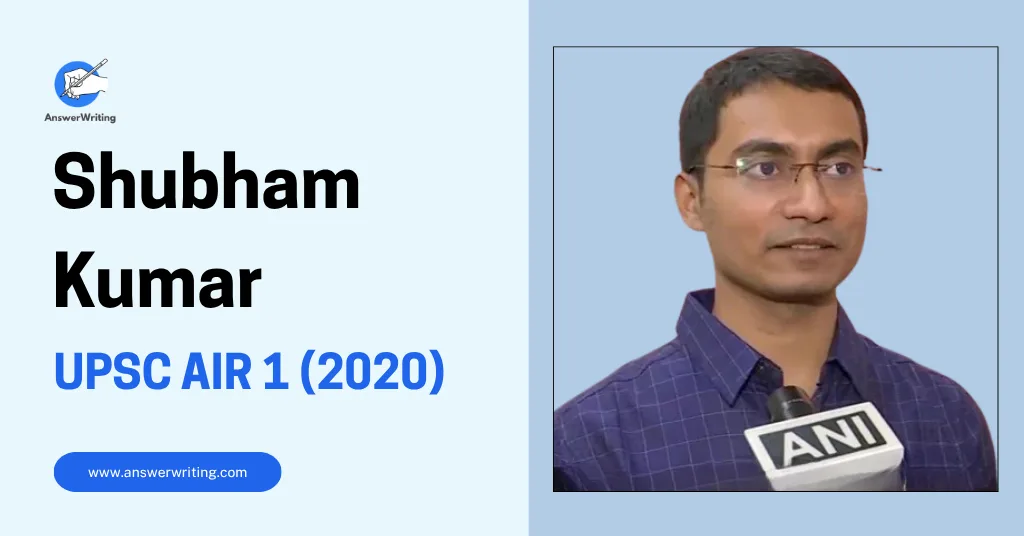
His story is worth studying not for inspiration alone, but for the specific, replicable decisions he made at every stage.
Who Is Shubham Kumar?
Shubham Kumar is the UPSC Civil Services Examination 2020 topper, securing All India Rank 1 in results declared in September 2021. He is from Katihar, Bihar, and comes from a family where his father works in the state irrigation department, as per available reports.
He completed his B.Tech in Civil Engineering from IIT Bombay, one of India’s premier engineering institutions. He chose Anthropology as his optional subject and cleared the exam in his third attempt.
Here is a quick profile snapshot:
| Detail | Information |
|---|---|
| Full Name | Shubham Kumar |
| UPSC CSE Year | 2020 |
| All India Rank | 1 |
| Attempt Number | 3rd |
| Optional Subject | Anthropology |
| Home State | Bihar |
| Educational Background | B.Tech, Civil Engineering, IIT Bombay |
| Service Allotted | IAS |
| State Cadre | Bihar (as per available reports) |
Shubham Kumar UPSC Marksheet and Score Details
The figures below are based on widely reported data and should be cross-checked from the official UPSC website for complete accuracy.
| Component | Marks (as per available reports) |
|---|---|
| Essay | 148 |
| General Studies Paper 1 | 105 |
| General Studies Paper 2 | 108 |
| General Studies Paper 3 | 111 |
| General Studies Paper 4 | 119 |
| Anthropology Paper 1 | 160 |
| Anthropology Paper 2 | 175 |
| Written Total | 826 |
| Interview (Personality Test) | 182 |
| Grand Total | 1008 |
Two numbers here demand attention. His Anthropology scores, 160 and 175, show what deep optional preparation looks like in practice. And his interview score of 182 was widely discussed across the UPSC community as exceptionally high. Both will be covered in detail in the sections below.
Educational Background and Early Life
Shubham Kumar grew up in Katihar, a town in eastern Bihar. It is not a metropolitan city with UPSC coaching centres on every street. It is the kind of place where cracking IIT itself is considered a significant achievement.
He cleared the JEE and enrolled in the Civil Engineering programme at IIT Bombay. That academic environment, rigorous, analytical, and competitive, clearly shaped his approach to structured problem-solving. Those habits transferred directly to how he eventually tackled UPSC preparation.
The decision to leave an engineering career path for civil services was a conscious one. An IIT degree opens doors in the private sector. Choosing to walk past those doors and sit for a government exam three times takes clarity of purpose. For Shubham, that purpose was rooted in wanting to work on ground-level development challenges in Bihar, the state he came from.
That grounding in a specific “why” is something many aspirants underestimate. It shapes your interview answers, your essay framing, and your ability to sustain preparation through difficult stretches.
How Many Attempts Did Shubham Kumar Take?
Shubham Kumar cleared UPSC CSE in his third attempt.
His first two attempts did not result in a final selection. Rather than treating those attempts as setbacks, he treated them as data. Each one revealed something specific about where his preparation was falling short.
Between his earlier attempts and his successful third attempt, the key shifts, as per available reports, were:
Answer writing quality: He identified that knowing content was not enough. The ability to present that content within UPSC’s expected structure and word limits was a separate skill that needed dedicated practice.
Optional subject depth: Anthropology rewards candidates who go beyond surface-level coverage and connect physical anthropology, social anthropology, and Indian ethnography into a cohesive understanding. He deepened this integration significantly by his third attempt.
Interview preparation: He invested more structured effort in DAF-based preparation and current affairs integration ahead of the Personality Test.
Three attempts might sound discouraging to some aspirants. What Shubham’s example actually shows is that each attempt, when treated as a genuine feedback loop rather than a repeat of the same preparation, compounds into something stronger.
Shubham Kumar’s Optional Subject: Anthropology, Why an Engineer Chose It and How It Scored
This is one of the most searched aspects of Shubham Kumar’s preparation, and for good reason.
Anthropology is not an obvious choice for a Civil Engineering graduate. But the logic behind it is sharper than it first appears.
Why Anthropology works for engineers:
Anthropology has a relatively well-defined, static syllabus. Unlike optional subjects with vast and constantly evolving reading lists, Anthropology’s core content does not shift dramatically year to year. For someone coming from a non-humanities background, this predictability is a significant advantage.
The subject also has two papers with distinct characters. Paper 1 covers the theoretical and biological dimensions of Anthropology. Paper 2 focuses on Indian society, tribes, and applied Anthropology. Together, they create overlap with GS Paper 1 (Indian society and culture) and GS Paper 4 (ethics and human values), giving a well-prepared candidate reinforcement across multiple papers.
Shubham’s combined Anthropology score of 335 across both papers is a direct result of this depth. He did not just read the syllabus. He built a conceptual map of the subject and practiced applying it to diverse question types.
Key resources for Anthropology optional:
- NCERT Sociology textbooks for foundational social concepts
- Ember and Ember for cultural Anthropology
- P. Nath for Indian Anthropology and tribes
- Previous years’ question papers, mapped topic by topic
For aspirants considering Anthropology as an optional, Shubham’s score makes a strong case. But the subject rewards consistency and conceptual clarity over last-minute cramming. Start early and build the framework before adding detail.
UPSC Preparation Strategy of Shubham Kumar
Shubham Kumar’s preparation combined structured coaching with strong self-study discipline. He attended Vision IAS coaching in Delhi, as per available reports, but did not treat coaching as a substitute for independent thinking.
His preparation had several clear pillars:
Prelims: He focused on NCERT foundations across all subjects before moving to standard reference books. He treated Prelims as a stage that required its own dedicated preparation window, not just a by-product of Mains reading. Regular MCQ practice was central to his Prelims approach.
Mains GS Papers: He built his GS preparation around a small, curated set of sources rather than reading everything available. He prioritised depth over breadth, a choice that reflects the reality that UPSC Mains rewards analytical answers, not encyclopaedic ones.
Current Affairs: He maintained a daily newspaper reading habit and linked every major current affairs development to a specific GS syllabus heading. This mapping habit meant his current affairs preparation fed directly into his answer writing rather than sitting as disconnected facts.
Revision: He built at least three full revision cycles into his schedule. First revision after completing a topic. Second revision before mock tests. Third revision in the final weeks before the exam.
Study Hours: As per available reports, he maintained a 10 to 12 hour daily study routine during peak preparation phases, with deliberate rest built in to sustain that pace over months.
Books and Resources Recommended by Shubham Kumar
The following list is compiled from widely reported interviews and should be cross-checked from his direct interactions for complete accuracy.
| Subject | Book / Resource | Author / Source |
|---|---|---|
| Indian History | NCERT Class 6 to 12 | NCERT |
| Modern History | India’s Struggle for Independence | Bipan Chandra |
| Indian Polity | Indian Polity | M. Laxmikanth |
| Economy | Indian Economy | Ramesh Singh |
| Geography | NCERT Class 11 and 12, Certificate Physical Geography | NCERT, G.C. Leong |
| Environment | Environment by ShankarIAS | ShankarIAS Team |
| Science and Technology | The Hindu Science and Tech coverage | The Hindu |
| Ethics (GS4) | Ethics, Integrity and Aptitude | G. Subba Rao and P.N. Roy Chowdhury |
| Anthropology Optional | Cultural Anthropology | Ember and Ember |
| Anthropology Optional | Indian Anthropology | P. Nath |
| Anthropology Optional | IGNOU Anthropology Material | IGNOU |
| Current Affairs | The Hindu | Daily Newspaper |
| Current Affairs | Vision IAS Monthly Current Affairs | Vision IAS |
| Essay | Previous Years’ Essay Papers | UPSC |
Mains Answer Writing Approach
Shubham Kumar’s Mains performance was built on one habit above all others: writing answers regularly, under timed conditions, from early in his preparation.
He did not wait until he felt “ready” to start writing. He wrote answers throughout his preparation, which meant his writing quality improved in parallel with his content knowledge rather than lagging behind it.
His answer structure followed a consistent pattern. Introductions were brief and contextual, either a definition, a relevant fact, or a direct engagement with the question. Body paragraphs were organised around distinct points with supporting evidence. Conclusions pointed toward policy implications, constitutional values, or the way forward, rather than simply restating the introduction.
He paid particular attention to word limits. UPSC Mains answers have specific word count expectations, and candidates who routinely overshoot or undershoot those limits lose marks not because of what they know but because of how they manage their writing.
One of the most effective ways to build this discipline is through regular evaluated practice. Writing an answer and filing it away teaches you very little. Writing an answer and receiving specific, structured feedback on what worked and what did not, that is where real improvement happens.
AnswerWriting.com’s Daily Answer Writing feature is built exactly for this kind of practice. Fresh prompts every day, a consistent writing habit, and the ability to track your improvement over time gives aspirants the structured repetition that toppers like Shubham built into their routines manually. Pairing that with the platform’s Answer Evaluator, which gives AI-powered feedback on structure, content, and UPSC scoring parameters, creates a feedback loop that is hard to replicate through self-review alone.
Interview (Personality Test) Experience
Shubham Kumar’s interview score of 182 out of 275 is one of the standout numbers in his marksheet. At a stage where most strong candidates score between 140 and 160, a score of 182 reflects exceptional preparation and in-room performance.
The UPSC Personality Test is not about impressing the board with how much you know. It is about demonstrating that you can think clearly, communicate honestly, and hold a position under gentle pressure without becoming defensive or evasive.
Shubham’s DAF would have drawn heavily from his IIT Bombay background, his Bihar roots, his Civil Engineering degree, and his choice to pursue civil services over an engineering career. Each of these is a natural entry point for the board to probe his values, his awareness of development challenges, and his understanding of governance.
His preparation approach, as per available reports, involved:
- Reviewing every entry in his DAF and anticipating questions that could emerge from each one
- Staying current with Bihar-specific development issues, infrastructure challenges, and governance debates
- Practising mock interviews to build composure and calibrate his response style
- Reading about Civil Engineering’s relevance to public infrastructure, an area where his technical background gave him a genuine edge in the interview room
The lesson from his 182 is straightforward. The interview rewards authenticity paired with preparation. You cannot fake clarity of thought. But you can prepare well enough that your genuine thinking comes through without being obscured by nervousness or vague answers.
Service and Cadre Allotted to Shubham Kumar
Shubham Kumar was allotted the Indian Administrative Service (IAS) as AIR 1 of UPSC CSE 2020. As per available reports, he was allotted the Bihar cadre, which aligns with his stated preference to work in his home state.
His current posting details should be verified from official government sources or LBSNAA announcements, as postings change over time and any specific role mentioned here may no longer reflect his current assignment.
Key Lessons Every UPSC Aspirant Can Take from Shubham Kumar
- Your degree does not define your optional. Shubham studied Civil Engineering at IIT Bombay and chose Anthropology. The right optional is the one that aligns with your ability to score, not the one that matches your graduation subject. Evaluate each option strategically before committing.
- Three attempts is not a failure pattern, it is a refinement pattern. Each of Shubham’s attempts built on the previous one. If you have attempts behind you, the question is not how many times you have tried. The question is what specifically you have changed each time.
- Interview preparation is not an afterthought. A score of 182 does not happen by accident. It happens when a candidate treats the Personality Test as a separate, serious preparation phase with its own timeline and method. Start DAF preparation early.
- Depth beats breadth in both optional and GS. Shubham’s Anthropology scores and his GS performance both reflect a candidate who went deep into fewer sources rather than skimming across many. Curate your reading list and commit to it fully.
- Writing is a skill that compounds. The gap between a candidate who writes answers daily and one who only reads is enormous by the time Mains arrives. Build the writing habit early, seek feedback consistently, and treat every answer as a small exam in itself.
FAQs About Shubham Kumar
What is Shubham Kumar’s AIR in UPSC CSE 2020? Shubham Kumar secured All India Rank 1 in UPSC Civil Services Examination 2020, with results declared in September 2021.
What was Shubham Kumar’s optional subject in UPSC? His optional subject was Anthropology. He scored 160 in Paper 1 and 175 in Paper 2, for a combined score of 335, as per available reports.
How many attempts did Shubham Kumar take to clear UPSC? He cleared the exam in his third attempt.
Which college did Shubham Kumar study in? Shubham Kumar completed his B.Tech in Civil Engineering from IIT Bombay.
Which coaching did Shubham Kumar attend for UPSC? As per available reports, he attended Vision IAS coaching in Delhi. However, his preparation was a strong combination of coaching and independent self-study.
What was Shubham Kumar’s interview score? His interview score was 182 out of 275, as per available reports. This is widely regarded as one of the higher interview scores in recent UPSC history.
Which cadre was Shubham Kumar allotted? As per available reports, Shubham Kumar was allotted the Bihar cadre under the IAS. Official details should be verified from government sources.