
An IIT Bombay graduate, working as a software engineer in South Korea, quit a comfortable international career to attempt UPSC for the first time. He came back as India’s top-ranked IAS officer of 2018.
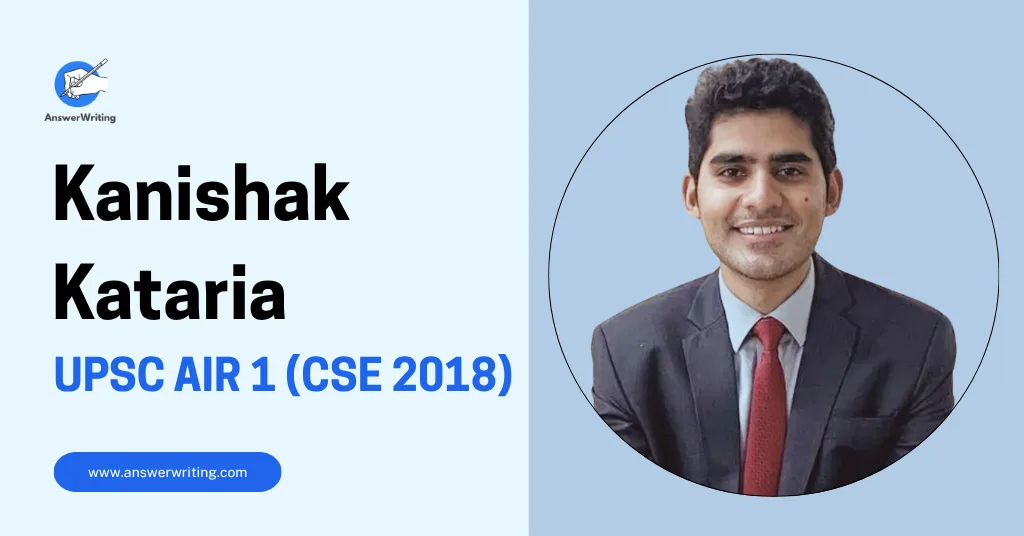
That is Kanishak Kataria’s story in one sentence. But the details behind that sentence are what every serious aspirant needs to understand.
Who Is Kanishak Kataria?
Kanishak Kataria secured AIR 1 in the UPSC Civil Services Examination 2018, with results declared in April 2019. He belongs to Rajasthan and was allotted the IAS with the Rajasthan cadre.
He graduated from IIT Bombay with a B.Tech in Computer Science in 2014. Before preparing for UPSC, he worked as a software engineer at Samsung R&D in South Korea. He chose Mathematics as his optional subject and cracked the exam in his very first attempt.
Quick Profile
| Detail | Information |
|---|---|
| Full Name | Kanishak Kataria |
| AIR | 1 |
| Exam Year | UPSC CSE 2018 |
| Attempts | 1 (First attempt) |
| Optional Subject | Mathematics |
| Service | IAS |
| Cadre | Rajasthan |
| Educational Background | B.Tech (CS), IIT Bombay |
| Prior Work | Software Engineer, Samsung R&D, South Korea |
Kanishak Kataria UPSC Marksheet and Score Details
As per widely reported figures, here is Kanishak Kataria’s score breakdown:
| Stage | Marks Obtained | Maximum Marks |
|---|---|---|
| Mains Written | 1121 | 1750 |
| Interview (Personality Test) | 175 | 275 |
| Final Total | 1296 | 2025 |
His Mathematics optional scores were particularly remarkable. As per available reports, he scored close to 486 out of 500 across both papers combined, which played a decisive role in securing AIR 1.
GS paper-wise individual breakdowns are not officially published in granular detail. Aspirants should cross-check specific sub-scores from official UPSC marksheet disclosures or verified interview sources.
Educational Background and Early Life
Kanishak was born and raised in Rajasthan. He cleared the IIT-JEE and enrolled at IIT Bombay, one of India’s most competitive institutions, graduating in Computer Science in 2014.
His engineering training gave him two things that proved invaluable during UPSC: analytical problem-solving and comfort with quantitative reasoning. These are not traits most humanities graduates bring to optional subject selection.
After IIT, he moved to South Korea for his role at Samsung R&D. That phase exposed him to structured thinking, deadlines, and high-performance work culture. When he returned to prepare for UPSC, those habits came with him.
How Many Attempts Did Kanishak Kataria Take?
Kanishak cleared UPSC in his first attempt. No prior failures, no near-misses, no demoralizing rejections to recover from.
But that does not mean his preparation was casual. He spent approximately one year in focused, structured preparation before appearing for CSE 2018. He treated that one year the way most multi-attempt candidates treat their final, decisive attempt.
This is the mindset shift worth noting. He did not prepare hoping to pass. He prepared to top.
For aspirants on their second or third attempt, this should not be discouraging. It should reframe how you approach your next attempt. One disciplined year, done correctly, is enough.
Kanishak Kataria’s Optional Subject: Mathematics
Why He Chose Mathematics
Kanishak chose Mathematics as his optional, a subject that many aspirants consider high-risk due to its abstract nature and the technical preparation it demands.
For him, it was a calculated decision, not a gamble.
He had studied Mathematics at an advanced level throughout his engineering years. The subject was not new territory. He did not have to build conceptual understanding from scratch the way a humanities student switching to a science optional would.
Mathematics also has a significant scoring advantage when prepared well. The answers are objective. There is no subjectivity in evaluation. A correct derivation gets full marks, regardless of how the examiner interprets your language or framing.
How He Scored in Mathematics
As per available reports, Kanishak scored approximately 486 out of 500 in Mathematics (combined across Paper I and Paper II). This is an extraordinary score by any standard and a major reason he secured AIR 1.
Books and Strategy for Mathematics Optional
He focused on standard reference books used across IIT-level mathematics and UPSC-specific resources. His approach was to master the fundamentals deeply, practice previous year questions extensively, and ensure presentation was clean and stepwise.
Aspirants choosing Mathematics as an optional should note: syllabus coverage and answer presentation matter as much as conceptual accuracy.
UPSC Preparation Strategy of Kanishak Kataria
Self-Study vs. Coaching
Kanishak followed a largely self-directed preparation strategy. He used coaching selectively for specific guidance rather than depending on classroom instruction as his primary learning mode.
This model works particularly well for candidates with strong academic backgrounds who can read, process, and retain information independently.
Study Hours and Discipline
As per various interviews and reported accounts, he followed a disciplined daily schedule during his preparation year. He prioritised consistency over marathon sessions, which is a pattern seen across most toppers regardless of background.
GS Approach
His engineering background shaped how he approached General Studies. He focused on understanding concepts deeply rather than rote memorising facts. For subjects like Economy and Science and Technology, this analytical foundation helped him structure answers logically.
For History, Polity, and Geography, he relied on standard NCERT textbooks as his base and built upward from there.
Current Affairs
He followed newspapers regularly and made concise notes. He linked current events back to static syllabus topics, which is the correct method for Mains answer enrichment.
Books and Resources Recommended by Kanishak Kataria
As per available interviews and reported sources, here is a subject-wise breakdown of resources aligned with his preparation:
| Subject | Book / Resource | Author / Source |
|---|---|---|
| History (Ancient, Medieval) | NCERT Textbooks (Class 6 to 12) | NCERT |
| Modern History | India’s Struggle for Independence | Bipan Chandra |
| Indian Polity | Indian Polity | M. Laxmikanth |
| Economy | Indian Economy | Ramesh Singh |
| Geography | NCERT Geography (Class 6 to 12) | NCERT |
| Environment and Ecology | Shankar IAS Environment | Shankar IAS Academy |
| Ethics (GS4) | Lexicon for Ethics | Niraj Kumar |
| Current Affairs | The Hindu / PIB | Daily Reading |
| Mathematics Optional | Standard IIT-level reference texts | Topic-specific sources |
Cross-check this list against his official interviews, as specific book mentions may vary across sources.
Mains Answer Writing Approach
Kanishak’s Mains score of 1121 out of 1750 was competitive but not unusually high compared to some other toppers. His Mathematics optional score is what elevated his final rank significantly. That said, his GS answer writing was clearly structured and exam-ready.
His approach followed principles that most UPSC mentors recommend: start with a crisp introduction, use subheadings to break the answer, include examples or data points, and close with a forward-looking conclusion.
He also practiced writing answers within word and time limits, which is non-negotiable in Mains preparation.
For aspirants working on answer writing, the challenge is always the gap between knowing content and presenting it effectively under exam conditions. Platforms like AnswerWriting.com help bridge exactly that gap. Its AI-powered Answer Evaluator gives detailed feedback on structure, content coverage, language, and UPSC scoring parameters, so you can identify weaknesses in your writing before the actual exam rather than after.
Consistent daily practice with real feedback is how answer writing improves. Reading model answers alone is not enough.
Interview (Personality Test) Experience
Kanishak scored 175 out of 275 in the Personality Test, which is a solid score though not unusually high. This suggests his interview performance was confident and competent rather than exceptional, and his written performance did the heavy lifting for AIR 1.
His Detailed Application Form (DAF) would have reflected his IIT background, Samsung work experience, and Rajasthan roots, all of which are natural territory for board questions.
As per available reports, he prepared for the interview by revisiting his DAF thoroughly, staying current on national and international affairs, and practicing structured articulation of his views. The specific board details and question sets from his interview are not widely verified and will not be reproduced here.
Service and Cadre Allotted to Kanishak Kataria
Kanishak Kataria was allotted the Indian Administrative Service (IAS) with the Rajasthan cadre. As the CSE 2018 topper, he had first preference in service and cadre selection.
His current posting and administrative assignments should be verified from official government or news sources, as postings change over time and this article does not aim to carry potentially outdated placement information.
Key Lessons Every UPSC Aspirant Can Take from Kanishak Kataria
- Play to your academic strengths. Kanishak chose Mathematics because he genuinely excelled at it, not because it was fashionable or because someone else succeeded with it. Your optional subject should come from your strongest subject area, not from toppers’ lists alone.
- One focused attempt beats multiple casual ones. He treated his first attempt as his only attempt. That level of seriousness changes how you allocate time, energy, and resources every single day of preparation.
- An engineering or science background is an asset, not a handicap. Many science graduates assume UPSC is designed for humanities students. Kanishak’s AIR 1 with a Mathematics optional from an IIT background disproves that completely.
- Mains writing requires deliberate practice, not just content knowledge. Knowing the answer is not the same as writing it well under time pressure. Regular practice with feedback is what closes that gap.
- Score where you can dominate. His optional paper scores were near-perfect. Identifying where you can score highest and maximising those papers is a legitimate and smart strategy.
FAQs About Kanishak kataria
What was Kanishak Kataria’s optional subject in UPSC? He chose Mathematics as his optional subject and scored approximately 486 out of 500 across both papers, as per available reports.
How many attempts did Kanishak Kataria take to clear UPSC? He cleared UPSC CSE 2018 in his very first attempt and secured AIR 1.
Which IIT did Kanishak Kataria attend? He graduated from IIT Bombay with a B.Tech in Computer Science in 2014.
Did Kanishak Kataria take coaching for UPSC? He followed a primarily self-directed preparation strategy and used coaching selectively, rather than relying on full-time classroom coaching.
What service and cadre was Kanishak Kataria allotted? He was allotted IAS with the Rajasthan cadre as the CSE 2018 topper.
What was Kanishak Kataria’s total score in UPSC CSE 2018? As per available reports, his final total was 1296 out of 2025, including 1121 in Mains written and 175 in the Personality Test.
Can engineers crack UPSC with Mathematics optional? Kanishak Kataria’s AIR 1 is the most direct answer to this question. Engineers with strong Mathematics foundations have consistently performed well with this optional.