
Why do many aspirants score well in GS1 and GS3 but struggle in GS2?
The reason is simple. GS2 demands constitutional thinking, governance awareness, and balanced arguments. It is not enough to memorize facts. You must show that you understand how the Indian state functions.
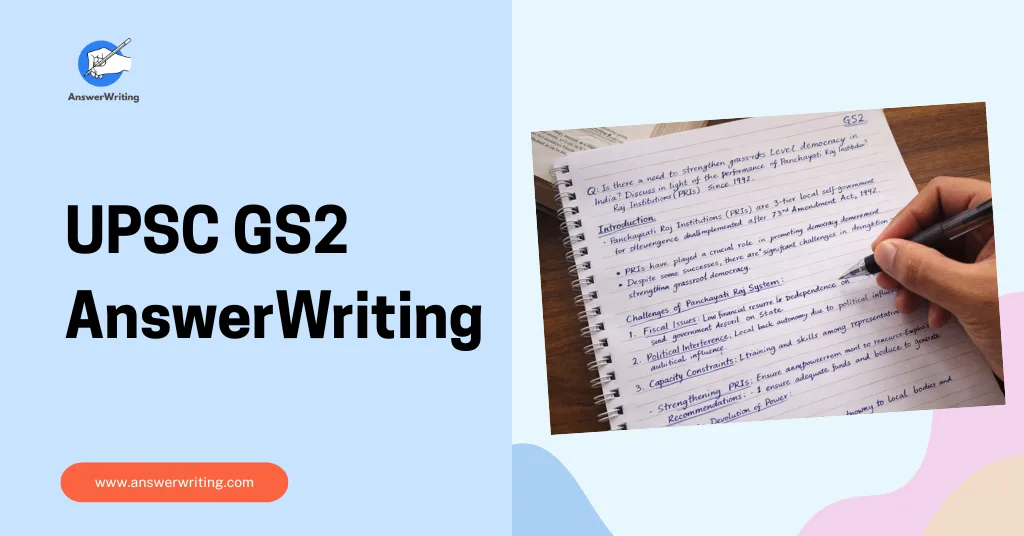
Many aspirants read standard books like Indian Polity but still lose marks because their answers lack structure, articles of the Constitution, and contemporary relevance.
Strong GS2 answers combine constitutional provisions, Supreme Court judgments, committee recommendations, and current affairs. The ability to integrate these elements within 150 to 250 words often decides the final score.
For serious aspirants, GS2 answer writing practice becomes as important as studying the syllabus itself.
Why GS2 Answer Writing Is Different from Other GS Papers
GS2 deals with the institutional structure of the Indian state. Questions usually test whether you understand governance challenges and constitutional values.
Unlike GS1 or GS3, GS2 answers must often refer to articles of the Constitution, judicial interpretations, and policy debates.
GS2 Topics and What UPSC Looks For
| GS2 Topic | What UPSC Expects in Answers | Sources to Use |
|---|---|---|
| Constitution | Understanding of constitutional principles | Articles, Constituent Assembly debates |
| Parliament & State Legislatures | Legislative functioning and accountability | Rules of procedure, committees |
| Judiciary | Judicial review, independence of judiciary | Supreme Court judgments |
| Federalism | Centre–state relations and cooperative federalism | Finance Commission, Inter-State Council |
| Welfare Schemes | Governance effectiveness and implementation | Government reports, NITI Aayog |
| International Relations | Strategic interests and diplomacy | Current affairs, treaties |
UPSC often asks analytical questions such as the effectiveness of institutions or the balance between rights and governance.
This makes answer writing skills critical.
Core Components of a High-Scoring GS2 Answer
Writing a Strong Introduction
The introduction should be short. Usually two or three lines.
You can begin with:
- A constitutional article
- A recent news event
- A governance concept
Example:
If the question concerns fundamental rights, referencing Article 21 or a relevant Supreme Court judgment immediately shows conceptual clarity.
Avoid long historical introductions. UPSC prefers direct and precise answers.
Building the Analytical Body
The body should explain the issue from multiple angles. Good GS2 answers combine legal foundations with practical governance issues.
Use the following elements when relevant:
- Constitutional provisions
- Supreme Court judgments
- Committee recommendations
- Current affairs examples
- Advantages and challenges
For instance, a question on federalism can include references to Finance Commission recommendations, GST Council cooperation, and debates on fiscal autonomy.
Such references strengthen analytical depth.
Writing a Balanced Conclusion
Conclusions should be constructive. Avoid repeating the body.
You can end with:
- Constitutional values such as justice or equality
- The need for institutional reform
- A committee recommendation
A forward-looking tone creates a strong impression on the examiner
How to Use Constitutional Articles and Judgments Effectively
Constitutional references make GS2 answers authoritative. However, aspirants should use them accurately and only when relevant.
Frequently Used Articles in GS2 Answers
| Article | Theme | Where It Can Be Used |
|---|---|---|
| Article 14 | Equality before law | Rights, governance fairness |
| Article 19 | Freedom of speech and other freedoms | Media, civil liberties |
| Article 21 | Right to life and personal liberty | Privacy, dignity, welfare |
| Article 32 | Right to constitutional remedies | Role of Supreme Court |
| Article 356 | President’s Rule | Federalism debates |
Landmark judgments also strengthen answers.
Examples include:
- Kesavananda Bharati case (1973), established the Basic Structure doctrine.
- Maneka Gandhi case (1978), expanded interpretation of Article 21.
- S.R. Bommai case (1994), placed limits on misuse of Article 356.
If unsure about details, aspirants should cross-check the exact judgment facts before using them in answers.
Integrating Current Affairs in GS2 Answers
GS2 is closely linked with governance developments. Many questions are inspired by recent debates.
Examples include:
- Supreme Court rulings
- Parliamentary reforms
- Government welfare schemes
- International diplomatic developments
Suppose a question concerns judicial accountability. You can mention discussions around judicial appointments or debates related to the collegium system.
Linking current affairs with constitutional principles shows mature understanding.
Smart Presentation Techniques for GS2
Presentation matters in UPSC Mains. Examiners read hundreds of answers every day.
Clear and structured writing makes evaluation easier.
Useful techniques include:
- Use small subheadings inside answers
- Write key constitutional terms such as federalism or judicial review
- Draw simple flowcharts for governance processes
- Use balanced viewpoints rather than extreme opinions
- Highlight important terms lightly
These techniques improve readability and clarity.
Common Mistakes Aspirants Make in GS2 Answers
Many aspirants repeat the same mistakes.
Common issues include:
- Writing generic answers without constitutional references
- Ignoring Supreme Court judgments
- Explaining theory instead of addressing the question
- Lack of clear structure
- Weak or repetitive conclusions
Another frequent mistake is overwriting introductions. In a 150 word answer, spending five lines on background reduces space for analysis.
Practicing concise writing solves this problem.
How Regular Answer Evaluation Improves GS2 Scores
Writing answers alone is not enough. Feedback is necessary.
Many aspirants struggle to judge whether their answers contain the right constitutional references or analytical balance.
Platforms such as AnswerWriting.com allow aspirants and teachers to evaluate handwritten answers for UPSC and State PSC examinations. Structured feedback helps identify problems in presentation, content depth, and time management.
Regular evaluation gradually improves answer quality and confidence.
Quick Framework for Writing Any GS2 Answer
A simple framework can guide writing during the exam.
7-Step GS2 Answer Framework
| Step | What to Write |
|---|---|
| 1 | Brief introduction with constitutional context |
| 2 | Define the key concept in the question |
| 3 | Present the main issue or debate |
| 4 | Add constitutional articles or judgments |
| 5 | Include current affairs example |
| 6 | Discuss challenges or limitations |
| 7 | End with a constructive solution or constitutional value |
Using such a structure keeps the answer focused and balanced.
Conclusion
UPSC Mains rewards clarity and constitutional understanding.
GS2 answers must show how institutions function, why governance challenges arise, and how constitutional principles guide solutions.
Aspirants who combine articles, judgments, current affairs, and structured writing usually perform better in this paper.
Consistent answer practice, followed by careful evaluation, gradually builds this skill. Over time, GS2 stops being the most unpredictable paper and becomes a scoring opportunity.
FAQs
1. How many constitutional articles should be used in a GS2 answer?
Usually one or two relevant articles are enough. Accuracy matters more than quantity.
2. Are Supreme Court judgments necessary in every answer?
No. Use them only when they directly strengthen the argument. Overusing case names can make answers look artificial.
3. How long should the introduction be in GS2 answers?
Two or three lines are sufficient. The main focus should remain on analysis.
4. Is current affairs compulsory in GS2 answers?
Current affairs greatly improve answers, especially for governance and international relations topics. However, they must be relevant.
5. How can beginners improve GS2 answer writing?
Start with previous year questions. Write answers regularly and get them evaluated through mentors or platforms such as AnswerWriting.com.