
How many people would walk away from the most coveted job in India just two years after winning it? Most aspirants spend half a decade trying to enter the “Steel Frame” of the Indian Administrative Service (IAS). Roman Saini did it at 22, in his first attempt, and then chose to leave.
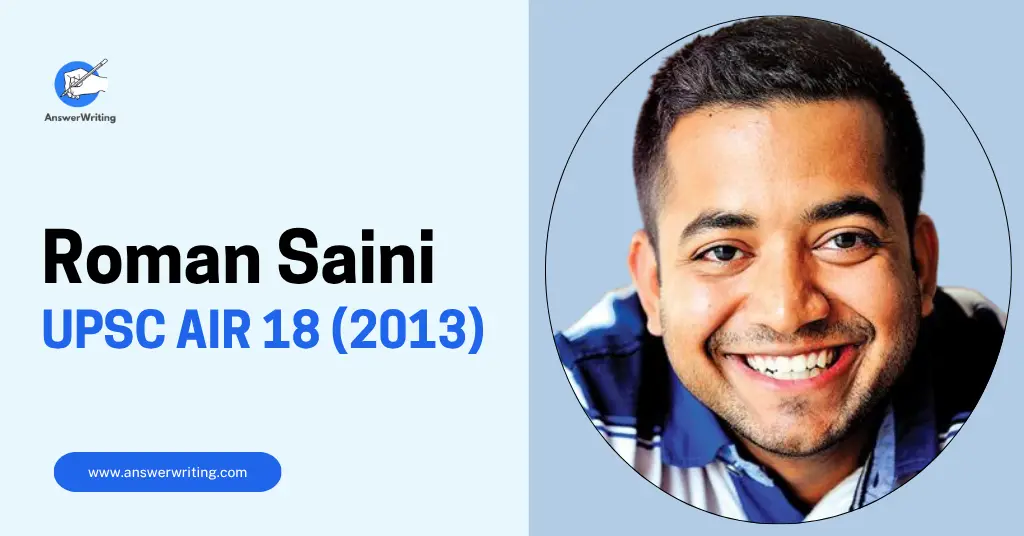
His story is not just about clearing an exam; it is about the courage to disrupt one’s own success to chase a larger vision.
Who Is Roman Saini?
Dr. Roman Saini is a 2014-batch IAS officer of the Madhya Pradesh cadre, a medical doctor, and a tech entrepreneur. Born in 1991 in Jaipur, Rajasthan, he became a national sensation when he secured All India Rank 18 in the 2013 UPSC Civil Services Examination. Before his UPSC success, he had already made history as one of the youngest individuals to clear the AIIMS entrance exam at age 16.
| Feature | Details |
| Full Name | Dr. Roman Saini |
| UPSC Rank | AIR 18 |
| Exam Year | 2013 |
| Service | IAS (Resigned in 2016) |
| Cadre | Madhya Pradesh |
| Age at Success | 22 Years |
| Educational Background | MBBS (AIIMS, New Delhi) |
Roman Saini UPSC Marksheet and Score Details
Roman Saini’s performance in the 2013 Mains was a testament to his “efficiency-first” approach. He scored 730 in the written papers, which was one of the highest in the country that year, coupled with a solid interview performance.
| Component | Marks Obtained |
| Essay | 145 |
| General Studies 1 | 097 |
| General Studies 2 | 061 |
| General Studies 3 | 108 |
| General Studies 4 (Ethics) | 098 |
| Medical Science Paper 1 | 109 |
| Medical Science Paper 2 | 112 |
| Interview (Personality Test) | 154 |
| Final Total | 884/2025 |
Educational Background and Early Life
Roman Saini was a child prodigy. Born into a modest family (his father was an engineer and his mother a homemaker), he studied in a Hindi medium school until Class 8. His transition to English medium was swift and successful. At just 16, he cleared the AIIMS entrance exam, a feat that requires immense mental clarity.
He completed his MBBS from AIIMS, New Delhi. While working as a junior resident, he witnessed the systemic issues in India’s healthcare. He realized that as a doctor, he could treat the symptom, but as an administrator, he could fix the cause (like sanitation and water). This realization sparked his UPSC journey.
How Many Attempts Did Roman Saini Take?
Roman Saini cleared the UPSC CSE in his first attempt.
What makes this even more remarkable is that he was a 21-year-old medical intern at the time. He did not have years to languish in coaching centers. He treated the exam like a puzzle to be solved. He famously ignored the “advice” to spend 15 hours a day studying, instead focusing on 6 to 8 hours of high-intensity, distraction-free work.
Roman Saini Optional Subject: Medical Science Strategy
Being a graduate of AIIMS, Roman chose Medical Science as his optional. His strategy was to leverage his professional training rather than starting a new subject from scratch.
- Integrated Learning: He used his internship knowledge to answer clinical questions.
- Selective Study: He focused on high-weightage topics like Medicine, Pediatrics, and Surgery.
- Syllabus Mapping: He strictly followed the UPSC syllabus to avoid over-reading medical textbooks.
For those choosing technical optionals like Medical Science, getting specific feedback is vital. The Optional Evaluator on AnswerWriting.com can help technical students ensure their answers bridge the gap between “academic depth” and “UPSC requirement.”
UPSC Preparation Strategy of Roman Saini
Roman Saini’s strategy was defined by the 80/20 Rule: 80% of the results come from 20% of the effort. He focused on the core areas that yielded the most marks.
Prelims Elimination Technique
He believed that Prelims is not just about knowing the right answer, but about eliminating the wrong ones. He practiced thousands of MCQs to develop an “intuition” for the exam. Aspirants can build this same instinct using MCQ Practice for Prelims on AnswerWriting.com, which provides topic-wise practice to master the art of elimination.
The “Risk-Taking” Approach
Unlike many who play it safe in Prelims, Roman advised attempting a high number of questions (85 to 95). He argued that if your elimination logic is sound, the statistical probability of a high score increases.
Minimalist Resources
He avoided “secret coaching notes.” He relied on the internet, Google searches, and standard NCERTs. He famously stated that any material you need is already in the public domain.
Books and Resources Recommended by Roman Saini
| Subject | Resource | Note |
| Polity | M. Laxmikanth | Read at least 10 times. |
| Economy | Mrunal.org & NCERTs | Focus on conceptual clarity. |
| History | Spectrum (Modern) & Old NCERTs | Ignore dates; focus on movements. |
| Geography | G.C. Leong & NCERTs (11-12) | Use Google Images to visualize. |
| Environment | Shankar IAS | A must-read for current contexts. |
| Ethics | Lexicon | Focus on case studies and keywords. |
Mains Answer Writing Approach
Roman Saini’s Mains strategy was purely clinical. He believed that the examiner has hundreds of copies to check and very little patience for “fluff.”
- Bullet Points: He rarely wrote long paragraphs. He broke every answer into distinct points.
- Directness: He answered the specific demand of the question in the first two sentences.
- Keywords: He used high-impact vocabulary to show authority over the subject.
To master this level of precision, regular feedback is essential. Platforms like AnswerWriting.com offer an Answer Evaluator that analyzes your structure and content against actual UPSC scoring parameters. This helps you trim the “noise” from your answers, much like Roman did during his preparation.
Interview (Personality Test) Experience
Roman was the youngest candidate interviewed by his board. Being 22 and an AIIMS graduate, he faced tough questions about why he was “wasting” a medical seat.
He remained calm and focused on his vision of “preventative governance.” He explained that providing clean water to a village saves more lives than a doctor can in a career. His honesty and lack of “coaching-style” rehearsed answers helped him secure a 154, a solid score that protected his high rank.
Service, Cadre, and the Historic Resignation
He was allotted the Madhya Pradesh cadre and joined as an Assistant Collector in Jabalpur. During his brief tenure, he worked on education and health initiatives. However, his heart was in “democratizing education.”
In January 2016, he took the world by surprise and resigned from the IAS. He co-founded Unacademy with his friends Gaurav Munjal and Hemesh Singh. His goal was to provide high-quality education to those who couldn’t afford expensive Delhi coaching, effectively becoming a mentor to millions.
Key Lessons Every UPSC Aspirant Can Take from Roman Saini
- Be a Smart Worker, Not a Donkey: Focus on the syllabus and previous year questions. Don’t read everything under the sun.
- Master the Internet: Use Google, Wikipedia, and YouTube. You don’t need to be in Rajinder Nagar to clear this exam.
- Decision Over Doubt: Once you decide on a strategy or an optional, stick to it with 100% conviction.
- The Power of First Attempt: Aim to clear it in the first go. The longer you stay in the cycle, the more the “baggage” weighs you down.
FAQs About Roman Saini
1. Did Roman Saini take coaching for UPSC?
No, he is a firm advocate of self-study. He primarily used NCERTs, standard books, and the internet to prepare.
2. Why did Roman Saini resign from the IAS?
He resigned to pursue his passion for education and co-found Unacademy, aiming to provide free or affordable learning to students across India.
3. What was Roman Saini’s rank and year?
He secured AIR 18 in the UPSC Civil Services Examination 2013.
4. What was his optional subject?
He chose Medical Science, leveraging his background as an MBBS graduate from AIIMS.
5. How old was he when he cleared UPSC?
He cleared the exam at the age of 22 in his very first attempt.
6. Which cadre was he allotted?
He was allotted the Madhya Pradesh cadre and served as an Assistant Collector before resigning.